Case Studies


Tree Seed Gathering and Growing


The need for trees

Trees, in both urban and rural areas, provide social, environmental, health, and economic benefits. They provide shelter and shade, and are an essential part of the habitat for a wide range of animal life. They help to filter out dust and other pollutants from the atmosphere and from the ground, helping to decontaminate derelict land. Trees can help stabilise slopes, reduce soil erosion and flooding. They provide renewable crops of timber, fuel and food, and form a beautiful element in the landscape in both town and country.

Since prehistoric times, human activity has led to a reduction of tree cover across the British Isles. In the past couple of hundred years, industrialisation, and a rapidly expanding population, has speeded the decline.

Today, there are 1.3 billion trees in England, (i.e. 25 trees for every person), the total area covered by woodland is 1,097,000 hectares, or 8.4% of the total land area. Some areas of England are much more wooded than others, in the Yorkshire and Humberside Region the woodland cover is about 6%, the South East woodland covers about 14% of the land. The government has set a target of 6.5% for the whole of Yorkshire by the year 2016 , this will entail the creation of 4000ha of new woodland.

Tree cover – Great Britain

Total area of woodland –
2.7 million hectares,
which is 11.6% of the total land area.

England - woodlands cover 8%
Wales – 14%
Scotland – 17%

Norfolk 7.9%
Surrey 22%
Yorkshire W.R. 4.5%

Tree cover – some EU
countries for comparison:

Austria 47%
Belgium 22%
France 28%
Germany 30%
Ireland 9.6%
Spain 28%

Other countries for comparison:

Brazil 64.3%
Japan 64%
New Zealand 29.7%
Canada 26.5%
USA 24.7%

Government agencies, local authorities, private industry, ngo’s, community groups and individuals are all involved in programmes and activities that will increase tree cover across Britain over the next century.

Involvement by Schools


Seed gathering and planting

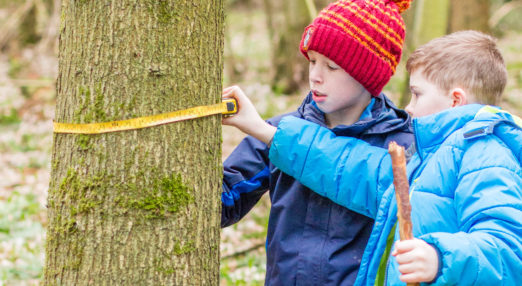
To help increase tree cover, and more importantly perhaps to persuade the next generation of the value of trees, Leeds City Council’s Learning and Leisure Department, run a ‘Tree Seed Gathering and Autumn Trees Day’ involving Leeds Primary Schools. The Council’s Forestry Section works in partnership with the British Trust for Conservation Volunteers in local woodlands in and around the city, to involve youngsters in the collection of seed from local trees so that they can grow their own tree seedlings and plant them out in their local area, (including school grounds).

The three hour session is divided into three activities:

A similar event was run in Sheffield, but with an extra historical element included.

One of the sessions is taken by a ‘mediaeval steward of the Lord of the Manor’, who describes how important woods are to the manor and to the local economy. He tells the groups how people have rights of ‘pannage’, (beechmast and acorns for pigs), ‘estover’ , (firewood), or ‘ploughbote’, (wood for making ploughs), for example, and how they must be very careful not to take wood without these rights or the lord’s consent.

Schools wishing to be involved with tree planting should contact their local authority and speak to the woodlands or trees officer for help and advice.

In support of their campaigns to help people enjoy and learn more about trees, The Tree Council have produced an excellent booklet - ‘The Good Seed Guide -all you need to know about growing trees from seed’.

(The address: The Tree Council, 51 St. Catherine Place, London SW1E 6DY.
Website: www.treecouncil.org.uk


The Juniper Project

An excellent example of how schools can become involved with growing trees is a project that has been underway in the north of the North Yorkshire Moors National Park since 2001. Peter Woods, who is an independent woodland and wildlife habitat management consultant, had noticed a decline in the number of juniper in the Park and elsewhere, and saw also that the surviving trees were often over a hundred years old and were not regenerating. With the help of a local nurseryman, who had done some research on juniper regeneration, seed was gathered and planted in a nursery. It took three years for the seed to germinate, and a further three for the seedlings to reach a reasonable size for planting out.


Old juniper in Baysdale, North Yorkshire Moors N.P.

‘Saving the Juniper’ clearly offered a wonderful opportunity for the involvement of local schools, and with the help of the Education Officer for the National Park, four primary schools, Lealholm, Castleton, Danby and Botton Village, and a small group of secondary pupils from West Redcar Community School, became involved.

The first 30 junipers were planted at five sites all within pollinating distance of the old surviving plants. Pupils were shown how to plant and protect the saplings with guards and stakes and to make sure that weeds would not smother them, used newspaper as a weed suppressant. Each plot of six saplings was then protected from grazing animals by a fence.

Each site has had follow up visits by the children to check on the growth of the trees, and in the autumn of 2002, pupils went out to collect seed from the mature trees in their areas. A total of 1,850 were collected and delivered to the nurseryman for propagation.

More planting was done in 2003, and the schools remain committed to their junipers. The programme has only just begun, each year more junipers will be ready for planting, more seed will need to be collected to keep the project running.

If you would like more information about the Juniper Project, and especially if you think you could help in regeneration and restocking the countryside with juniper, or indeed with other trees please contact 'Teaching Trees' at: info@teachingtrees.org.uk


Peter Woods showing a group one of the
schools' juniper plantations in Baysdale.


School Estate Days in Yorkshire

Across Yorkshire, The Countryside Foundation for Education, www.contrysidefoundation.org.uk runs annual Estate Days for schoolchildren.

The estates of Birdsall, Bramham, Kirklees, Garrowby and Wykeham offer children an opportunity to witness, at first hand, a wide range of countryside skills.

All the estates include Forestry in the activities available for children to watch.


Children learning about the uses of wood. Garrowby.


When children visit the woodland on the Estates they learn about tree felling and forestry operations. This usually includes:


Children following the development of young trees at Garrowby.


A group watching tree felling at Garrowby.

To find out more about booking a visit to an Estate Day contact
Gary Richardson at The Countryside Foundation for Education.
Tel. 01422 885566 or E-mail gary-richardson@countrysidefoundation.org.uk